
Continuous Professional Development
As an academic in the Department of Management and Entrepreneurship at the University of the Western Cape (UWC), I view continuous professional development (CPD) as both a professional obligation and a moral commitment to enhancing my effectiveness as a teacher, researcher, and mentor. My philosophy of CPD is grounded in the belief that education is a dynamic, evolving practice that requires consistent reflection, adaptation, and engagement with emerging pedagogical trends (Boud & Brew, 2013). Through continuous learning, I ensure that my teaching remains responsive to changing educational contexts, technological advancements, and the diverse needs of my students.
Over the past two years, I have pursued a structured and intentional professional development journey aimed at deepening my pedagogical competence, transforming my curriculum, and strengthening my scholarly identity. In 2023, I completed the Postgraduate Diploma in Higher Education Studies at the University of Cape Town (UCT). This qualification profoundly enhanced my understanding of pedagogy, curriculum theory, and transformation within the context of South African higher education. It strengthened my capacity to design learning environments that are inclusive, decolonial, and reflective of diverse epistemologies (Leibowitz, 2017).
Building upon this foundation, I am currently pursuing a Master of Education in Higher Education Studies at UCT. This programme is allowing me to engage more deeply with the theoretical and practical dimensions of higher education — particularly in areas such as academic leadership, assessment, curriculum renewal, and institutional transformation. This formal study has sharpened my ability to engage reflexively with my teaching practice, using critical reflexivity as a lens through which to examine the social, cultural, and epistemological dimensions of my pedagogical decisions (Schön, 1983; Finlay, 2008).
In addition to formal qualifications, I actively participate in university and sector-wide professional development workshops designed to enhance my teaching and learning practices. Over the past two years, I have attended several workshops and seminars on Artificial Intelligence (AI) in Education, the Scholarship of Teaching and Learning (SoTL), Decolonisation of the Curriculum, and Educational Technology. These engagements have
enriched my pedagogical toolkit by exposing me to innovative and evidence-based teaching strategies, digital learning tools, and reflective approaches to student engagement (Guskey, 2002). Through these professional learning activities, I have gained a deeper understanding of how technology and AI can be used to foster inclusive, adaptive, and student-centred learning environments — an area that aligns closely with my growing research interest in digitalpedagogy and technology-enhanced learning.
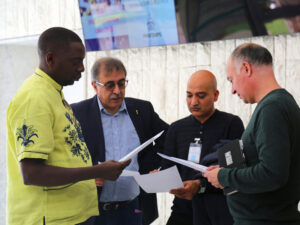
My participation in CPD activities reflects my belief that academic growth is a lifelong journey shaped by collaboration, reflection, and scholarly inquiry. I regularly engage with colleagues through communities of practice, departmental seminars, and teaching and learning symposia. These forums offer valuable opportunities to share best practices, engage in critical debate, and co-create knowledge in alignment with the principles of the Scholarship of Teaching and Learning (SoTL) (Trigwell & Shale, 2004). This collective engagement not only improves my own pedagogy but also contributes to the broader academic development culture within the
Faculty of Economic and Management Sciences at UWC.
In line with Schön’s (1987) concept of the reflective practitioner, I view CPD as an iterative process of reflection, action, and renewal. I consistently evaluate my teaching through student feedback, peer review, and personal reflection to identify areas for growth and innovation. My continuous professional learning ensures that I remain a relevant, reflexive, and transformative educator capable of inspiring my students to reach their fullest potential.
Ultimately, my engagement in CPD is about more than acquiring new skills — it is about embodying a lifelong learning mindset that prioritises critical inquiry, responsiveness to societal change, and the transformative potential of education. It reinforces my commitment to the UWC vision of fostering socially engaged, globally competitive, and critically conscious graduates.
References
- Boud, D., & Brew, A. (2013). Reconceptualising academic work as professional practice: Implications for academic development. International Journal for Academic Development, 18(3), 208–221. https://doi.org/10.1080/1360144X.2012.671771
- Finlay, L. (2008). Reflecting on reflective practice. Practice-Based Professional Learning Paper 52, The Open University. Guskey, T. R. (2002). Professional development and teacher change. Teachers and Teaching: Theory and Practice, 8(3), 381–391. https://doi.org/10.1080/135406002100000512
- Leibowitz, B. (2017). Higher education for the public good: Views from the South. Trentham Books.
- Schön, D. A. (1983). The reflective practitioner: How professionals think in action. Basic Books.
- Schön, D. A. (1987). Educating the reflective practitioner. Jossey-Bass.
- Trigwell, K., & Shale, S. (2004). Student learning and the scholarship of university teaching. Studies in Higher Education, 29(4), 523–536. https://doi.org/10.1080/0307507042000236407